One button for a wall of glass.
Tubular motors hidden inside the blind roll, controlled by remote, wall switch, phone app, voice assistant, timer or sensor. On Melrose Arch's wide and high glazing, it's often the only practical option — not just a nice-to-have.
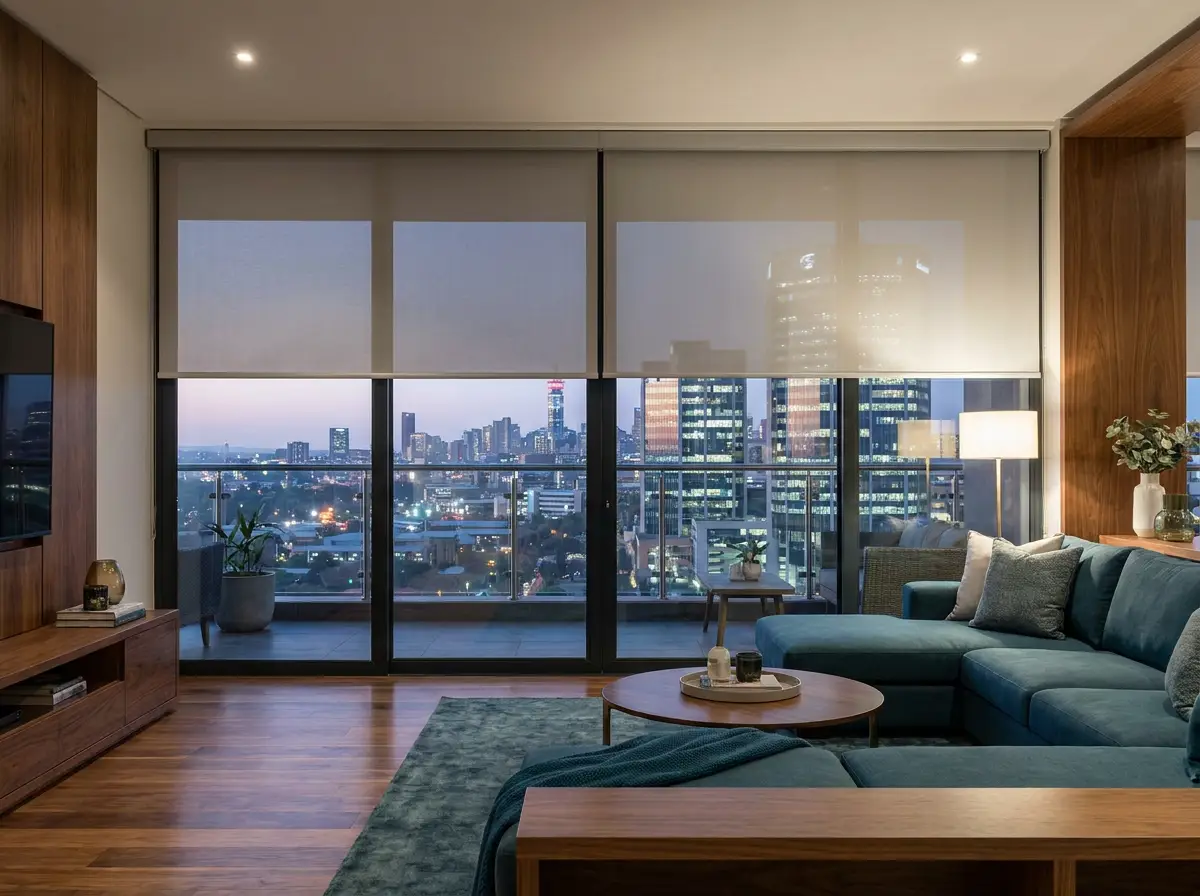
Power options
Rechargeable battery motors need no wiring and retrofit easily into an existing Melrose Arch unit — charge every few months via a USB-style charger. This is the default choice for apartments and retrofits.
Wired 220V motors suit new builds and renovations — permanent, no charging, and the better call for big or heavy systems and exterior products. This needs an electrician and a bit of planning, so it's worth raising early if you're renovating.
Solar trickle options exist for awkward positions where neither of the above is convenient.
Control, by lifestyle
A single handset remote can run every blind in a room, or the whole apartment. App control lets you check "did I leave the west blinds up?" from the office. Schedules can open bedroom blinds at sunrise and drop the western glass automatically in the heat of the afternoon. Sun sensors do the same job without a schedule, and — critically for exterior products — wind sensors retract awnings and exterior screens automatically before a Highveld storm gust does any damage. Voice or smart-home integration rounds it out for the automation-minded owner.
When motorisation is essentially required
Spans too wide or heavy for a chain, blinds above stair voids or double-volume glass, concealed ceiling-recess systems, exterior venetians, folding-arm awnings, zip screens, and multi-blind glass walls where "one button, six blinds" is the whole point — these are the cases where motorisation stops being optional.
Safety, honestly
No dangling chains is the most child-safe operation there is — see our note on child safety. Quality motors are quiet, not silent, and carry multi-year guarantees. Battery motors do need that periodic charge; we set that expectation clearly at quote stage so there are no surprises after installation.
What motorisation costs
Motorisation carries no price of its own — you are buying a product that happens to have a motor in it. Across the range fitted here, motorised shading runs about R2,500 to R7,500 per square metre installed: a motorised roller blind at R2,500 to R3,800, a motorised day/night blind at R2,800 to R4,000, and a motorised folding-arm awning at R5,500 to R7,500 per square metre of projection.
Small openings are charged at a minimum whatever drives them, and a battery motor retrofitted into a finished apartment is a different job from a wired motor planned into a fit-out. Which one applies to your building, and what each opening costs, is settled at the free measure and put in writing.
Fitting motorised blinds across Melrose & Melrose Arch
Motorisation is the default spec on most of the jobs we run here — wide glass walls in Dunkeld's rebuilds, high apartment glazing in Illovo and Birdhaven, and double-volume openings in Houghton Estate all lean on app control or a wind sensor rather than a chain.
Ready to measure your windows?
Free in-home measure, written per-window quote, no pressure.