Two Melroses share one postcode: a 1902 suburb under Henry Brown Marshall's oaks, and a red-brick pedestrian precinct built out of glass. The sun treats them very differently. This is what we've learned about the light on this patch, what we'd fit on each elevation, and the honest catch with every one of those answers.
Henry Brown Marshall bought 713 acres north of the Johannesburg CBD in 1893, built his house on it and planted the oaks that still give this suburb its canopy. The township was laid out in 1902, and roughly 200 of those original homes survive.
The other Melrose launched in 1998, its current precinct built from 2007 and finished in November 2009 — 170,000 m² of office and retail plus apartments and two hotels, laid out as cobbled alleys and red-brick buildings that give preference to pedestrians. Glass behaves nothing like a 1902 sash.
So the useful unit here is not the house. It is the window.
The light here
26 degrees south, 1,753 metres up.
Melrose has no weather station of its own, so these figures are Johannesburg-wide — all sourced at the foot of the page.
01
Nearly overhead in December, low and due north in June
The midday sun climbs to around 88° at the December solstice — near vertical, so the roof and the balcony slab take most of the load. By June it sits at 40.8°, due north, right through the middle of the day: free winter warmth through the pane that cooked you in January.
02
In midsummer, first light lands at 05:13
December runs 05:13 to 19:00 — 13 hours 47 minutes of daylight; June gives you 06:55 to 17:25. Midsummer sunrise and sunset both sit south of the east–west line, so even a south room catches a slice at either end of a long day.
03
The oaks are deciduous — that is the whole catch
Marshall's oaks are generous shade through summer, exactly when the sun is nearest vertical and the roof is already doing the work — and bare in June and July, when it sits at 40° and arrives almost sideways at the glass.
04
Ultraviolet is the quiet expense
Johannesburg's monthly maximum UV index runs 14 to 16 at the height of summer, dropping to 6 or 7 midwinter. The World Health Organization notes UV rises with altitude and stays high under cloud. Gauteng averages about 3,066 hours of sunshine a year.
05
October and November are the storm months
Both carry a high frequency of severe storms over the Highveld — downpours, flooding, small hail, strong winds, lightning. Extreme hail is not annual: November 2013 brought two days of it that cost Gauteng insurers heavily.
Low sun is a sideways problem.
A blind that only moves up and down has one answer to a twenty-degree afternoon sun: cover the window and lose the room. A slat that tilts has a second — and a slat that tilts outside the glass has a third.
Elevation by elevation
Four aspects, four different problems.
Walk the place once with the compass on your phone. Aspect changes the answer more than the room does.
North — solve it with geometry before you spend
North glass takes a near-vertical sun in summer and a low one in winter, so it is the one aspect where a horizontal projection genuinely works: a balcony slab or a deep eave blocks most of December while still letting the whole of June in. Stand in the room at noon in February before you buy anything for that wall.
West — the aspect that ruins afternoons
The sun sets between roughly 244° and 296° across the year, and by then it is low: it arrives under the eave and straight at the glass, which is why the accepted answer for west glazing is vertical shading, or shading outside the pane. It is also where the oaks let you down hardest — the worst low-sun months are the bare ones.
East — same geometry, half the penalty
East glass gets the mirror image from 05:13 in midsummer, but the building fabric is still cool — so glare and waking at first light matter more than heat. An east bedroom is a blockout conversation; an east breakfast room usually is not.
South — not immune, just late to it
A south wall takes low direct sun early and late in December, then effectively none through winter — the coolest, flattest-lit rooms in the building. In a Melrose house they are often best left lightly dressed; above the piazza, south glass is almost purely a privacy question.
What we'd fit, and why
The reasoning — and the catch with each.
Each beats its obvious alternative somewhere specific, and each costs you something — so the catch is written beside it. Tap Add to my list and it carries down to the forms below.
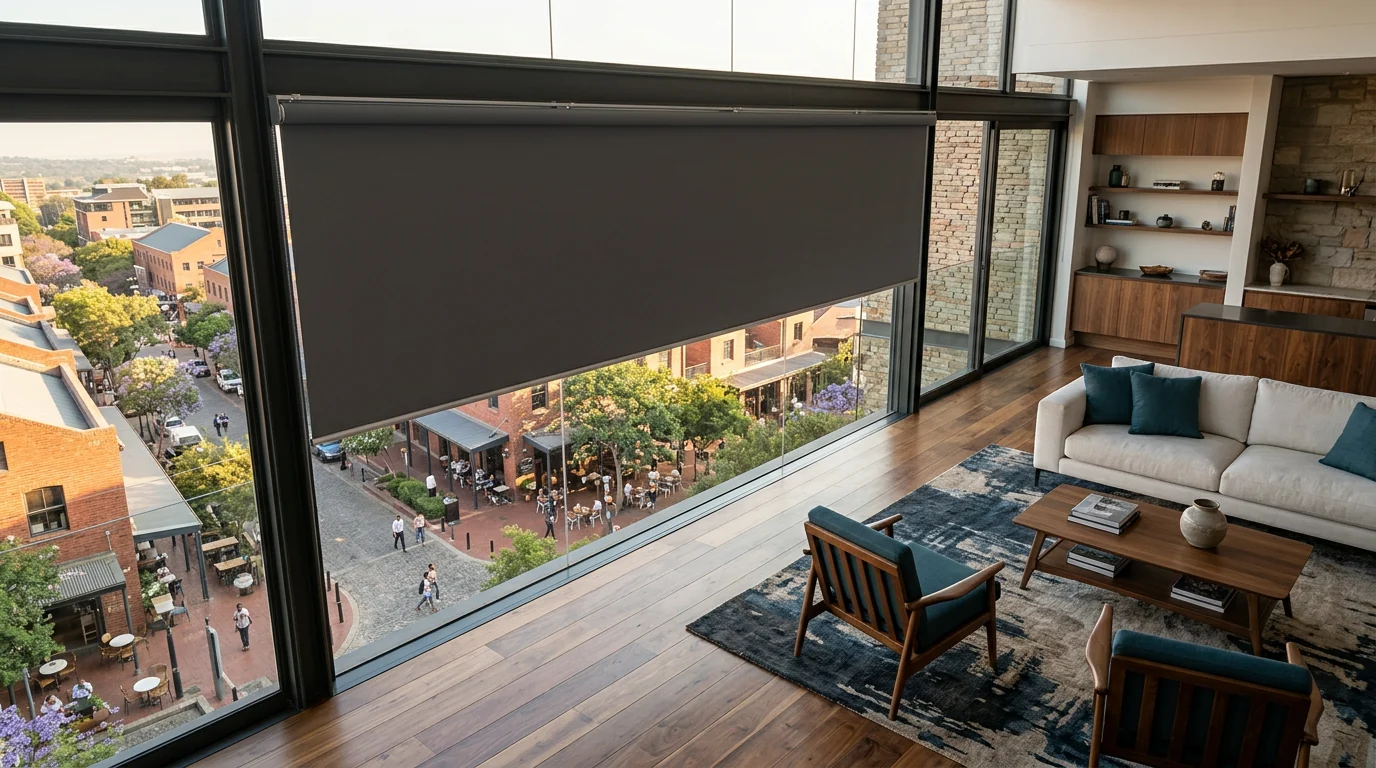
Roller blinds — sunscreen or blockout
Best on: piazza-facing living rooms (sunscreen) · bedrooms (blockout)
Why here. A 3–5% openness sunscreen keeps the outlook people buy here for, while cutting glare and much of the ultraviolet that fades floors at this altitude. Blockout does the opposite job, and first light at 05:13 is reason enough.
The catch. Sunscreen reverses after dark — lights on inside and it gives away more than you expect. Blockout is only as dark as its edges. A double roller puts both on one bracket, usually the real answer in a bedroom.
Day/night blinds
Best on: rooms fronting the piazza, a walkway or a facing block
Why here. Alternating sheer and solid bands slide past each other, so one blind moves from open view to eye-level privacy without being raised — far less final than dropping a blockout at four o'clock.
The catch. Never a true blockout, and the banding is a strong horizontal pattern: good against a modern aluminium frame, less so against period joinery.
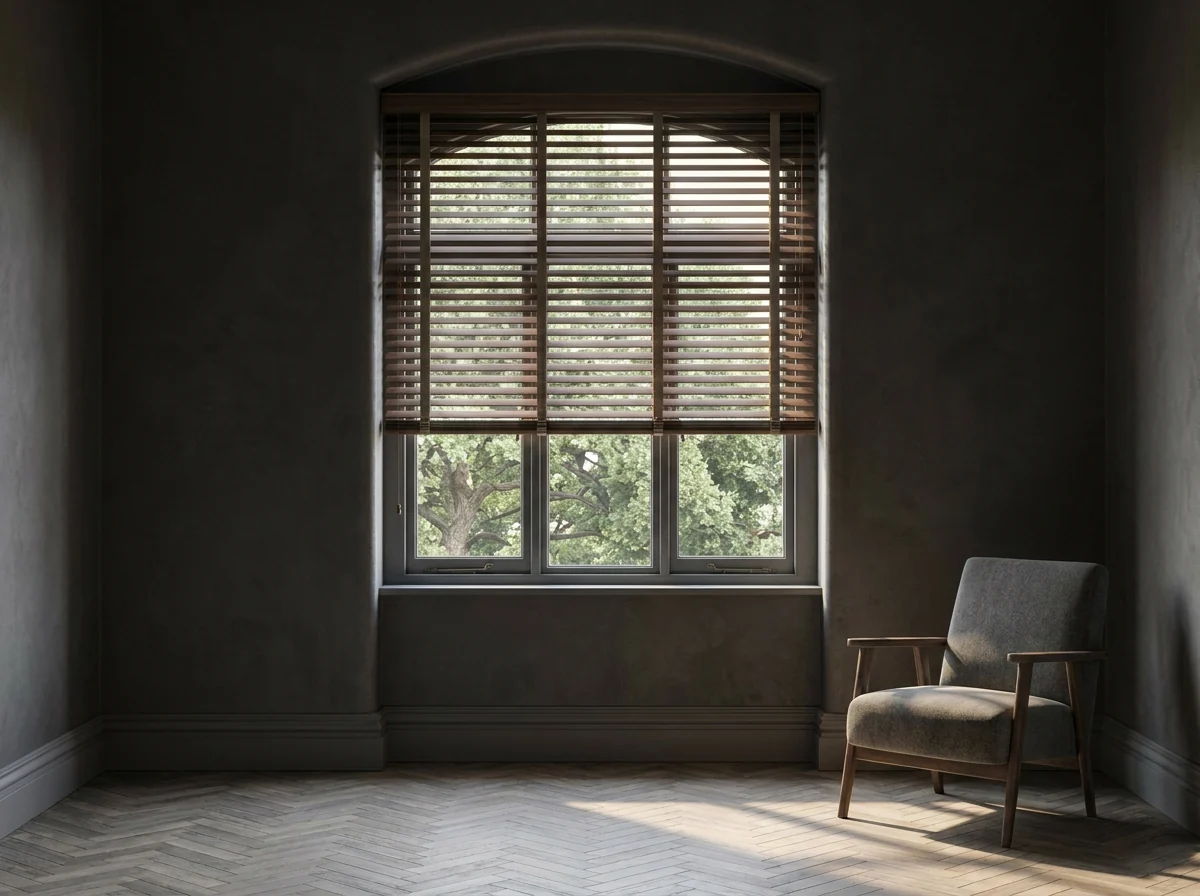
Timber & aluminium venetian blinds
Best on: studies and period reveals (timber) · kitchens and bathrooms (aluminium)
Why here. Low western sun is a sideways problem, and a tilting slat answers it sideways: close the angle and the room stays bright while the direct beam stops.
The catch. A timber venetian stacks deeper than a roller, so it eats more of the glass when fully raised — worth knowing before you specify it for a view. Timber dislikes steam, which is why wet rooms get aluminium.
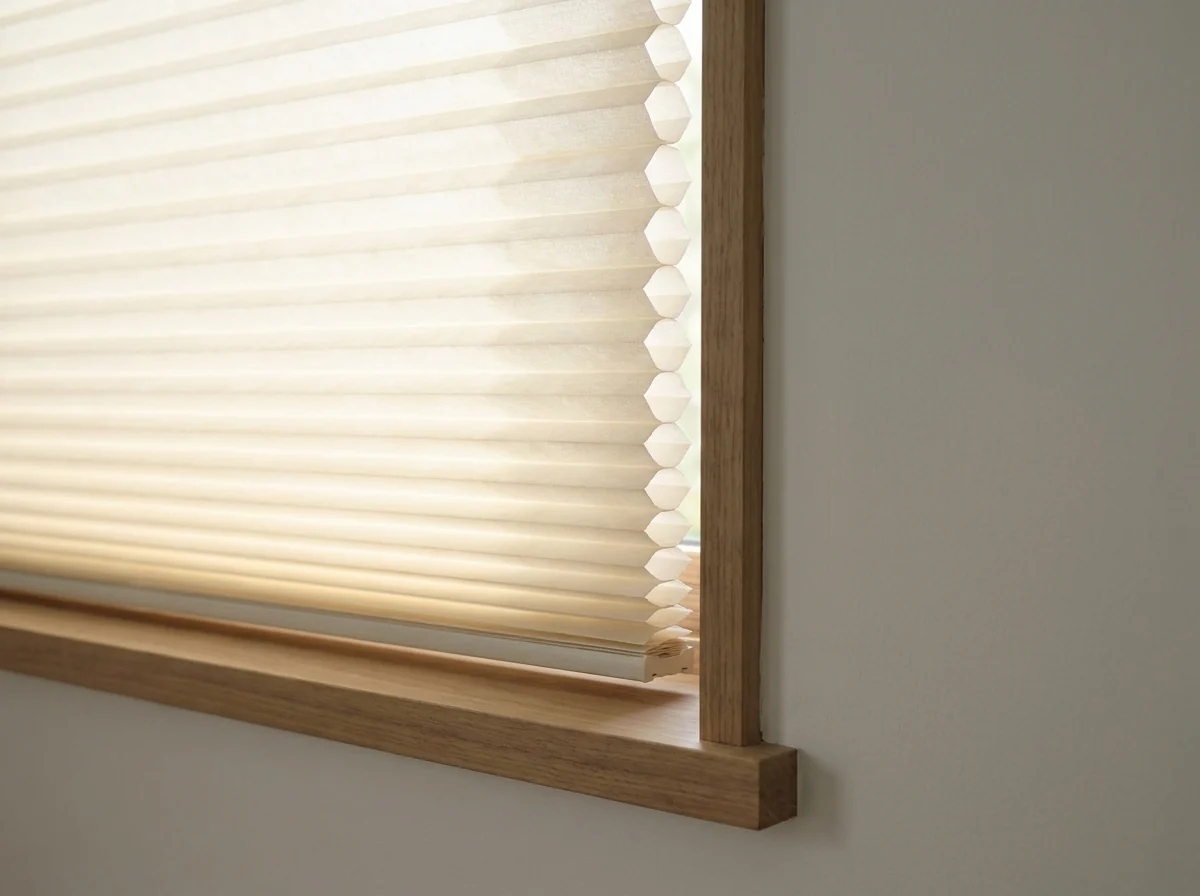
Cellular (honeycomb) blinds
Best on: single glazing you cannot or will not replace, and west-facing bedrooms
Why here. The fabric is formed into hexagonal cells that hold still air against the glass — in a 1902 room with single panes and a high ceiling, the least invasive comfort upgrade going. In an apartment it sits entirely inside the section, so nobody needs to approve it.
The catch. It is on the wrong side of the glass for summer heat gain: against a hard west sun an external product beats it, because a cellular blind only slows heat that already came through the pane. On a bad west window the answer is usually both.
Vertical, panel & concealed systems
Best on: wide sliding doors · frameless and double-volume glazing
Why here. Vanes and sliding panels cover a three-metre opening edge to edge and stack clear of the glass, so the door still works. A concealed system goes further — the blind lives in a ceiling slot and the glass reads bare when it is up.
The catch. Vertical vanes swing in the draught through an open door, and a panel blind needs wall to stack onto. Concealed systems must be planned before the ceiling closes — retrofitting one means a bulkhead, where a slim cassette headbox gets you most of the way for less upheaval.
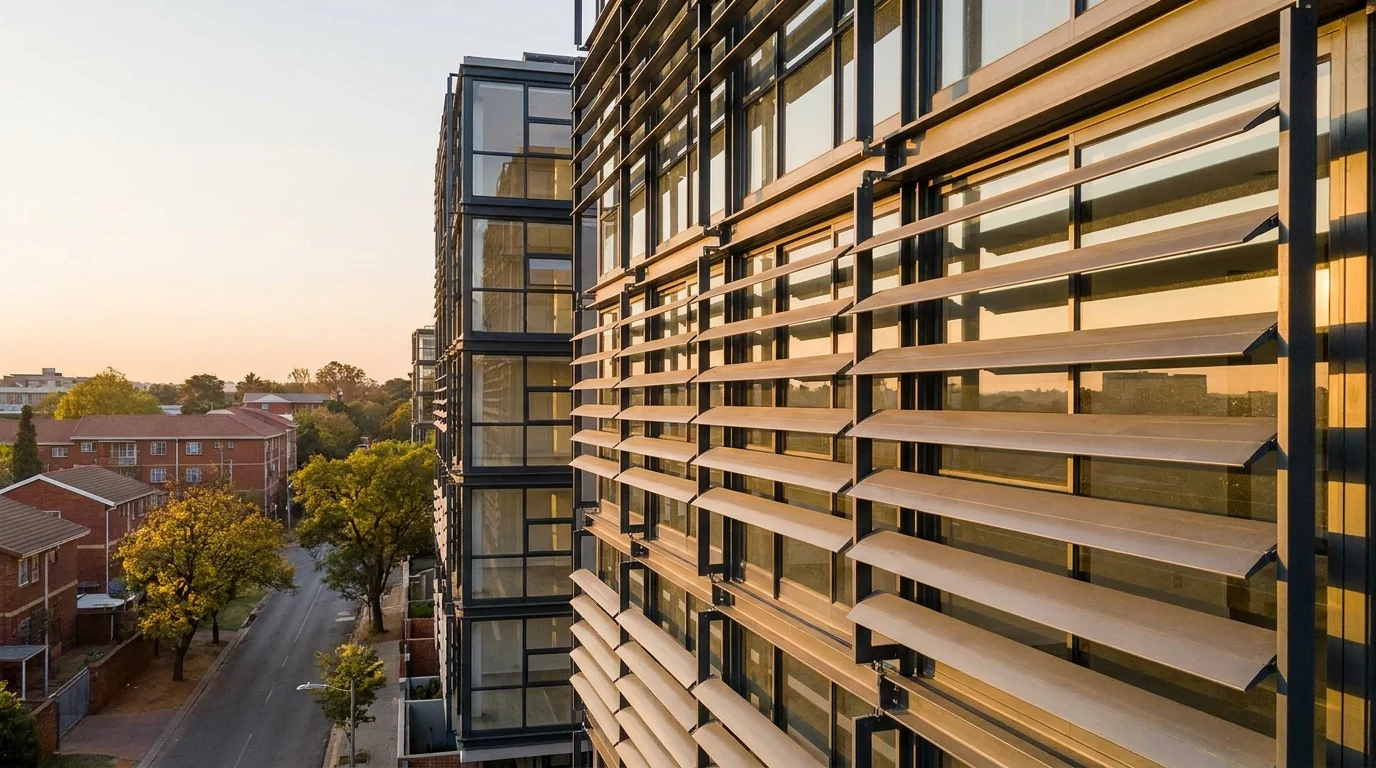
External venetians & roller shutters
Best on: hard west and north-west glass with nothing overhead
Why here. Both stop the sun outside the glass, which keeps a room cooler than absorbing it inside: an interior blockout kills glare instantly, but the pane behind it still heats and radiates all evening. External venetians tilt, so a view survives them.
The catch. In relative terms the dearest answers here. Both need a wind strategy through the storm season, both usually want a motor, and both change the outside of the building — a trustee conversation before it is a product one.
Shading, not security. What our roller shutters do is control sun, heat, glare and privacy from the outside of the glass. Security rating is a separate specification; we quote that on request.
Folding-arm awnings & zip screens
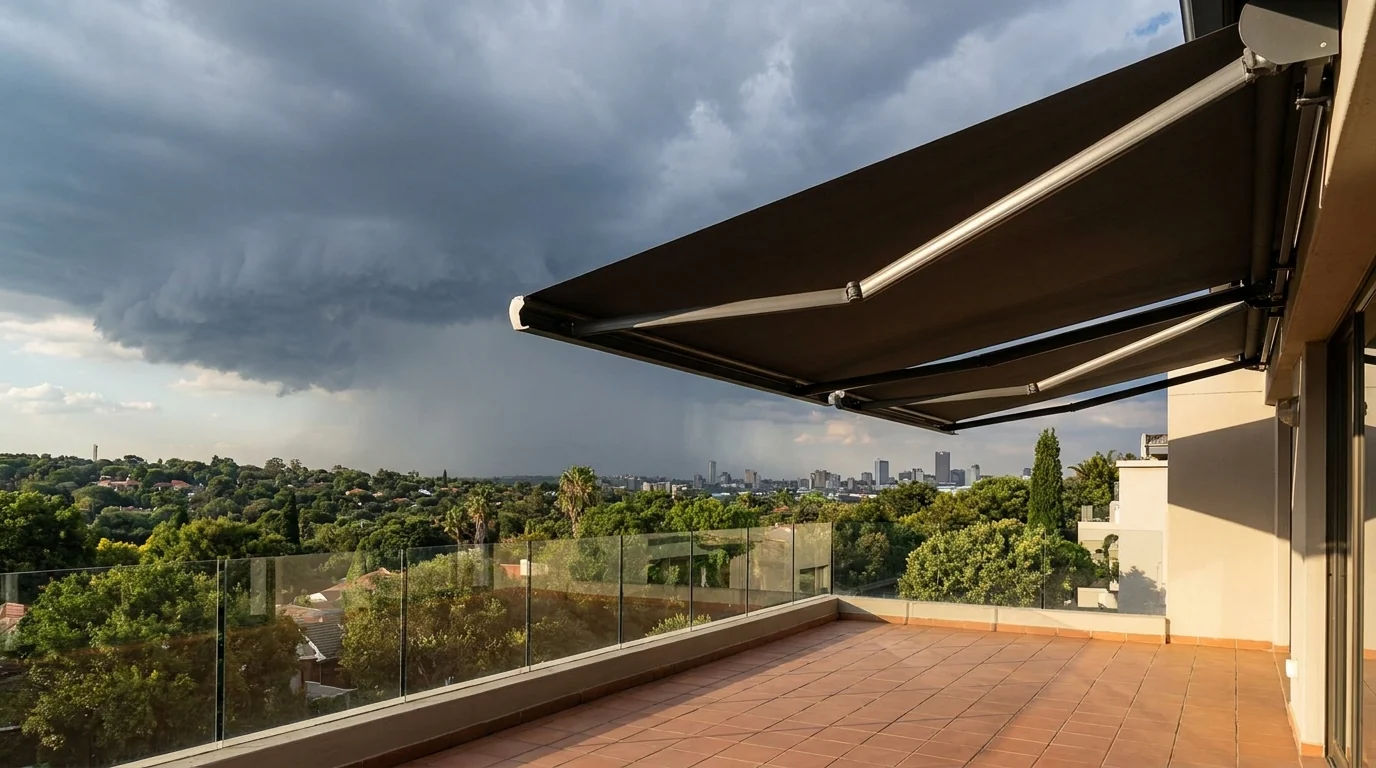
Best on: balconies, terraces, the stoep and the pool side
Why here. An awning shades a terrace with nothing standing in the way of the table, which is why it beats a fixed pergola where you still want the June sun back. A zip screen does a different job — fabric under tension in side channels, holding shape in wind.
The catch. Wind and hail ratings are engineering limits, not marketing copy, and an awning caught open in a November gust does not survive it. We would rather specify a motor and a wind sensor than a cheaper manual awning — and on an exposed upper balcony, sometimes a zip screen instead.
Motorisation, skylights & shaped glass
Best on: tall or wide glass, gables, stairwell and roof glazing, anything outdoors
Why here. A blind nobody can reach is a blind nobody adjusts. One button moves a whole wall of linked blinds; outdoors, a wind sensor retracts the awning before the storm arrives. With a December sun near 88°, roof and gable glass takes the most punishing angle on the building — and shaped blinds are tensioned to hold rather than sag.
The catch. Motors need power, and in a finished apartment a cable route that does not chase a wall is a genuine question — battery motors trade that for a charging routine you have to keep.
Optional
Want this Dossier marked up for your own place?
Tell us which rooms are the problem and we'll send it back with notes against your own elevations — which answers we'd start with, and which we'd leave alone. No visit, no obligation.
Trustees, and the sixty-year rule
Where the inside/outside line really sits.
Melrose's market has shifted decisively toward sectional title, and that changes a shading decision more than people expect. Prescribed Conduct Rule 5(1) puts it plainly: an owner or occupier "must not, without the trustees' written consent, make a change to the external appearance of the section or any exclusive use area allocated to it unless the change is minor and does not detract from the appearance of the section or the common property." Work that does not affect the outside appearance needs no approval at all.
Then there is age. Melrose was laid out in 1902, so an original house is comfortably past sixty years — and section 34(1) of the National Heritage Resources Act 25 of 1999 says nobody may alter or demolish a structure older than sixty years without a permit from the provincial heritage resources authority. Age alone is the trigger, register or no register.
That draws one clean line through this Dossier. Blinds fitted inside a room or a section change neither the structure nor how the building reads from outside. Anything mounted outside does. We are not heritage practitioners or your trustees, so we raise it at the measure, check the scheme's rules before quoting, and design the interior specification so you have a good option either way.
Nothing gets ordered before this
Five things the tape measure decides, not the Dossier.
The honest limit of any guide. Everything above narrows the field; these five decide it.
01
True reveal depth, and whether the opening is square
Depth decides whether an inside mount is possible at all, which decides how much light escapes past a blockout. A century of settling leaves older openings out of square, and apartment reveals are often shallower than they look. Measured in three places.
02
What the frame is made of, and what it will carry
Original timber, steel casement, modern aluminium and a plastered bulkhead each take a fixing differently, and some original joinery is either too soft or frankly too good to drill. Then we fix to the masonry instead.
03
How exposed that elevation really is
Anything external lives or dies on wind exposure. A ground-floor stoep behind a gable and an eighth-floor balcony thrown open to the west are different specifications, and sometimes different products.
04
Where the power for a motor can actually go
The cable has to arrive without chasing a wall or opening a finished ceiling, and in a sectional-title block it must not stray into common property. Sometimes a bulkhead solves it; sometimes a battery motor does.
05
What the oaks and the eave already do
A good share of the shade here is already free, and knowing which windows need no spending is worth as much as knowing which do — a judgement made standing in the room at four o'clock in February, not read off a plan.
Two ways in
Start with a measure, or start with a number.
Both start on the same short form.
Recommended
The free expert measure & written quote
A consultant comes to you with samples, walks the elevations at the hour that matters, measures every opening properly and leaves a written quote itemised per window. Free, and no obligation. We take five or six measure appointments a week, so the diary fills early — book ahead if you need a particular day.
A budget range follows the next working day, off nothing more than rough sizes. Not sure how to measure? Leave it out — our consultant measures for free either way, and that is where exact per-window pricing comes from.
One short form. Want a budget range too? Add rough sizes underneath — entirely optional.
Sources
Where the numbers on this page come from.
Every climate, sun-path, suburb, scheme and heritage figure above is taken from the following. Where something was disputed or could not be verified, we left it out rather than round it into a sentence.
Melrose's founding, Henry Brown Marshall's 1893 purchase, the 1902 layout, and the Melrose Arch development's cost, timeline, floor area, hotels and cobbled red-brick streetscape — Wikipedia, Melrose, Johannesburg
Reading this from a neighbouring window? The same sun-path reasoning applies across Dunkeld, Illovo, Birdhaven and Houghton Estate — it is the housing stock and the exposure that change.